
Direction Dependence Analysis
News:
- (January, 2026) New article on using principles of DDA: "Testing the validity of instrumental variables in just-identified linear non-Gaussian models" published in the British Journal of Mathematical and Statistical Psychology (click here for further details).
- (August, 2025) New book on DDA: "Direction Dependence Analysis: Foundations and Statistical Methods" published by Cambridge University Press (click here for further details).
- (April, 2025) New article on DDA: "Distinguishing cause from effect in psychological research: An independence-based approach under linear non-Gaussian models" published in the British Journal of Mathematical and Statistical Psychology (click here for further details).
- (March, 2025) New R package for DDA has been released no CRAN (click here for further details).
- (August, 2024) New article on applying DDA: "Shared micromobility, perceived accessibility, and social capital" published in Transportation (click here for the article).
- (August, 2024) New article on applying DDA: "Sleep quality and the cortisol and alpha-amylase awakening responses in adolescents with depressive disorders" published in BJPsych Open (click here for the article).
- (April, 2024) New article on applying DDA: "Evaluating the causal structure of the relationship between belonging and academic self-efficacy in community college: An application of Direction Dependence Analysis" published in Innovative Higher Education (click here for the article).
- (October, 2023) New article on DDA in the presence of causal effect heterogeneity: "Detecting heterogeneity in the causal direction of dependence: A model-based recursive partitioning approach" published in Behavior Research Methods (click here for the article).
- (September, 2023) New article on non-Gaussian covariate selection and covariate-based DDA: "Covariate selection in causal learning under non-Gaussianity" published in Behavior Research Methods (click here for the article).
- (August, 2023) New article on applying DDA: "Learning from bad peers? Influences of peer deviant behaviour on adolescent academic performance" published in the International Journal of Adolescence and Youth (click here for the article).
- (July, 2023) New article on applying DDA: "Interplay between language and mathematics comprehension/learning: A Direction Dependence Analysis" published in the International Journal of Education & Literacy Studies (click here for the article).
- (May, 2023) New article on applying DDA: "The influence of stressful life events on procrastination among college students: multiple mediating roles of stress beliefs and core self-evaluations" published in Frontiers in Psychology (click here for the article).
- (April, 2023) New article on applying DDA: "Television, authoritarianism, and support for Trump: A replication" published in Public Opinion Quarterly (click here for the article).
- (February, 2023) New article on applying DDA in mediation modeling: "Risk perception and graditude mediate the negative relationship between COVID-19 management satisfaction and public anxiety" published in Scientific Reports (click here for the article).
- (October, 2022) New article on applying DDA in mediation modeling: "What drives the perceived prejudice asymmetry among advantaged group members? The mediating role of social group power and moral obligations" published in the European Journal of Social Psychology (click here for the article).
- (March, 2022) New study protocol using DDA "Sleep quality and neurohormonal and psychophysiological accompanying factors in adolescents with depressive disorders: study protocol" published in BJPsych Open (click here for the article).
- (March, 2022) New article on applying DDA in mediation modeling: "Examination of serum metabolome altered by cigarette smoking identifies novel metabolites mediating smoking-BMI association" published in Obesity (click here for the article).
- (March, 2022) New article on software implementation of Conditional Direction Dependence Analysis (CDDA) in SPSS published in Social Science Computer Review (click here for the article).
- (February, 2022) New article on applying DDA "Positive teacher-student relationships may lead to better teaching" published in Learning and Instruction (click here for the article).
- (February, 2022) New invited article on causal inference using third higher moments: "Third moment-based causal inference" published in Behaviormetrika (click here for the article).
Workshops/Presentations:
- Columbia, MO, April 24, 2024: "On the problem of the wet toothbrush: Causal structure learning in observational data". Paper presented as the 2nd AI Forum of the University of Missouri, Columbia.
- Washington D.C., August 3-5, 2023 : "Analyzing the Direction Dependence across Subgroups when Competing Causal Theories are Supported".
- Hikone, Japan, September 10-11, 2021: "Direction Dependence Analysis: A Statistical Framework to Test Cause-Effect Asymmetry (or How to Retire the Mantra "Correlation ≠ Causation" in the Social Sciences). Paper presented online at the International Symposium on Causal Inference and Machine Learning, Shiga University and Behaviormetric Society supported by the RIKEN Center for Advanced Intelligence Project (API).
- Arlington, VA, September 26-29, 2021: "Variability of Effect Directionality across Subgroups: Examining Causal Assumptions in Moderation Analysis in Non-experimental Design".
- College Park, MA, January 25, 2021: "Direction Dependence Analysis: A Statistical Framework to Test the Causal Direction of Effects in Observational Data". Paper presented online at the Monday Symposium in Measurement and Statistics (MSMS) University of Maryland together with Ohio State University, University of North Carolina at Chapel Hill, and University of Notre Dame.
- Washington, D.C., August 6-8, 2020 (Annual American Psychological Association (APA) Convention): "Predictor-Residual Independence Tests for Examining Causal Assumptions of Synchronous Effects Models". Paper presented at the Symposium "Advanced Quantitative Methods for Addressing Complexities in Psychological Research".
- Arlington, VA, March 11-14, 2020 (Spring 2020 Conference of the Society for Research on Educational Effectiveness; SREE): "Examining the Causal Direction of Synchronous Effects In Structural Panel Models: Using Residual-Predictor Independence Tests to Identify Model Mis-specifications". Paper presented at the Symposium "Considerations and Choices in Modeling Complex Data".
- Lausanne, Switzerland, September 10-12, 2019 (31st Conference of the Austo-Swiss Region (ROeS) of the International Biometric Society): "Using Higher Moments to Test Requirements for Causal Inference".
- Basel, Switzerland, July 9-12, 2019 (Conference of the International School Psychology Association): "Prosocial Skills Causally Mediate the Relation Between Effective Classroom Management and Academic Competence: An Application of Direction Dependence Analysis". Paper presented at the Symposium "Specifying Mediators of Classroom Social-Behavioral Interventions".
- Chicago, IL, May, 26, 2019 (45th Annual Convention of the Association for Behavior Analysis International): "Direction Dependence Analysis: Testing the Direction of Causation in Non-Experimental Person-Oriented Research". Paper presented at the B. F. Skinner Lecture Series.
- Vancouver, BC, August 1, 2018 (Joint Statistical Meeting): "Direction Dependence Modeling: A Diagnostic Framework to test the Causal Direction of Effects in Linear Models". Paper presented at the Symposium "Recent Development in the Assessment and Modeling of Asymmetric Dependence".
- San Francisco, CA, May 24-27, 2018 (30th APS Annual Convention): "Conditional Direction Dependence Analysis: A Framework to Examine the Direction of Effect in Moderation with Implementation in SPSS".
What is Direction Dependence Analysis?
A common problem with observational research is that it is often difficult to prove that a specific action causes an effect. Further, in many cases, alternative causal theories exist which may serve as an explanation for observed variable associations. In non-experimental studies, at least three possible explanations exist for the association of two variables x and y:
I) x is the cause of y (i.e., x → y),
II) y is the cause of x (i.e., y → x),
III) an unmeasured confounder u is present (i.e., x ← u → y).
Direction Dependence Analysis (DDA) can be used to uniquely identify each explanatory model. DDA assumes that variables are non-normally distributed and makes use of higher moments (i.e., skewness and kurtosis) to gain deeper insight into the data-generating mechanism. DDA consists of three core components:
- Distributional properties of observed variables
- Distributional properties of error terms of competing models
- Independence properties of predictors and error terms of competing models
DDA component patterns can be used to uniquely distinguish between the three explanatory models. DDA patterns are summarized below (rectangles represent observed variables and circles represent unobserved variables). Statistical inference methods for model selection, SPSS macros, and R scripts to implement DDA are provided here. Please go to the RESOURCES section to download source codes, manuals, posters, slides, and further information.
Books:
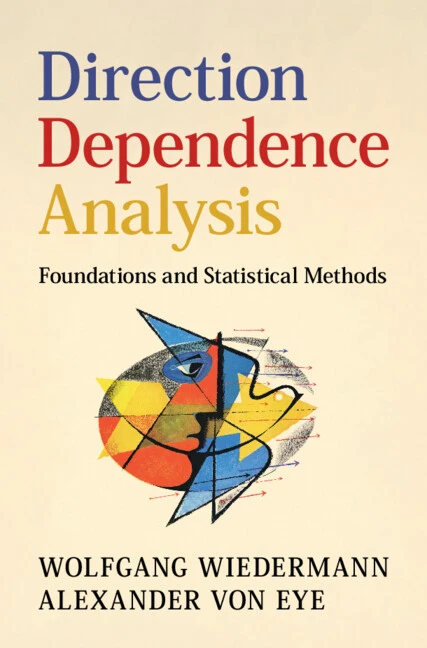
Direction Dependence Analysis: Foundations and Statistical Methods (2025, Cambridge University Press)
Book Description:
While regression analysis is widely understood, it falls short in determining the causal direction of relationships in observational data. In this groundbreaking volume, Wiedermann and von Eye introduce Direction Dependence Analysis (DDA), a novel method that leverages variable information often overlooked by traditional techniques, such as higher-order moments like skewness and kurtosis. DDA reveals the asymmetry properties of regression and correlation, enabling researchers to evaluate competing causal hypotheses, assess the roles of variables in causal flows, and develop statistical methods for testing causal direction. The book Direction Dependence Analysis: Foundations and Statistical Methods (Wiedermann & von Eye, 2015) provides a comprehensive formal description of DDA, illustrated with both artificial and real-world data examples. Additionally, readers will find free software implementations of DDA, making this an essential resource for researchers seeking to enhance their understanding of causal relationships in data analysis.
Reviews:
‘Will we ever find out which of the chicken or the egg came first? The answer may lie beyond the Gaussian world. This is the fascinating premise of this unique book, which distills 25 years of intensive research into the groundbreaking field of directional dependence analysis.’
Yadolah Dodge - Professor Emeritus, University of Neuchâtel, and Valentin Rousson, Associate Professor, University of Lausanne
‘Wiedermann and von Eye provide a singularly erudite, integrative, comprehensive, and accessible roadmap for using direction dependence analysis to illuminate new and greatly needed methodological advances for establishing causality in real-word data. Across psychological science and other disciplines, researchers will find that this book presents powerful and creative means to rigorously identify causal relations in both basic and applied research.’
Richard M. Lerner - Bergstrom Chair in Applied Developmental Science and Director, Institute for Applied Research in Youth Development, Tufts University
‘Wiedermann and von Eye’s new book describes a refreshingly new approach to causal inference based on directional dependence. The new method provides information other than theory and prior empirical work by which to assess the causal dependence between variables. It is the first comprehensive book on this new method and provides a well-organized and clearly written account of this unique method, with plenty of examples.’
David P. MacKinnon - Foundation and Regents Professor, Department of Psychology, Arizona State University
‘Correlation is not causality! Does X cause Y, or Y cause X? Because correlations are symmetric for X and Y, we can’t know… Until now!
‘I first encountered Direction Dependence Analysis (DDA) in a paper by this book’s authors. DDA is a brilliant idea: Use higher order moments to inform directionality. My thinking about correlations immediately became more nuanced and exciting. Read this book, and yours will too.’
Joe Rodgers - Professor Emeritus of Psychology and Human Development, Vanderbilt University
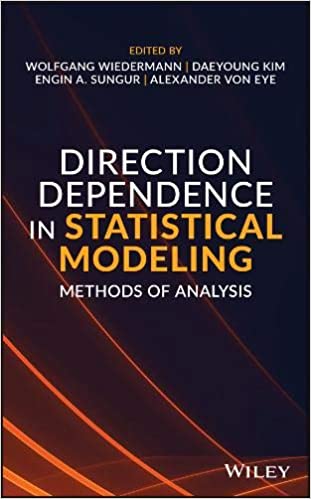
Direction Dependence in Statistical Modeling: Methods of Analysis (2021, Wiley)
Book Description:
Questions concerning the direction of dependence in statistical models are common in situations where causally competing theories exist to explain the relationship between variables. Such data situations are common in exploratory (hypothesis-generating) research settings but also occur in confirmatory research. The book Direction Dependence in Statistical Modeling: Methods of Analysis (Wiedermann, Kim, Sungur & von Eye, 2020, Wiley & Sons) gives an overview of the latest developments of methods for the analysis of hypotheses that are compatible with the causal direction of dependence of variable relations. The edited volume provides
- an introduction into principles of evaluating the presence of reverse causation (e.g., a causal model of the form y → x instead of x → y) and confounding biases (e.g., x ← u → y instead of x → y) in continuous and categorical variables,
- an introduction into copula-based directional dependence methods for continuous and categorical variables,
- an overview of state-of-the-art algorithms for causal learning,
- a discussion of statistical software, and various application examples using real-world data from developmental, epidemiological, and clinical research.
× 353

RESOURCES
PosterS AND SLIDES
SPSS mACROS
R SCRIPTS
uSER gUIDE & more
team
Network for Educator Effectiveness
University of Missouri
Department of Psychology
Michigan State University
REFERENCES
- Wiedermann, W. (2022). Third moment-based causal inference. Behaviormetrika.
- Wiedermann, W., Kim, D., Sungur, E., & von Eye, A. (2020). Direction dependence in statistical modeling: Methods of analysis. Hoboken, NJ: Wiley & Sons.
- Wiedermann, W., Reinke, M. W., & Herman, K. C. (2020). Prosocial skills causally mediate the relation between classroom management and academic competence: An application of direction dependence analysis. Developmental Psychology, 56, 1723-1735.
- Li, X. & Wiedermann, W. (2020). Conditional Direction Dependence Analysis: Evaluating the Causal Direction of Effects in Linear Models with Interaction Terms. Multivariate Behavioral Research, 55, 786-810.
- Wiedermann, W., & Sebastian, J. (2020). Sensitivity analysis and extensions of testing the causal direction of dependence: A rejoinder to Thoemmes (2019). Multivariate Behavioral Research, 55, 523-530.
- Wiedermann, W., & Li, X. (2020). Confounder detection in linear mediation models: Performance of kernel-based tests of independence. Behavior Research Methods, 52, 342-359. [R Scripts]
- Wiedermann, W., & Sebastian, J. (2020). Direction dependence analysis in the presence of confounders: Applications to linear mediation models. Multivariate Behavioral Research, 55, 495-515. [R Scripts]
- Wiedermann, W., Li, X., & von Eye A. (2019). Testing the causal direction of mediation effects in randomized intervention studies. Prevention Science, 20, 419-430.
- Wiedermann, W. (2018). A note on fourth-moment based direction dependence measures when regression errors are non-normal. Communications in Statistics: Theory and Methods, 47, 5255-5264.
- Wiedermann, W., & Li, X. (2018). Direction dependence analysis: Testing the direction of effects in linear models with implementation in SPSS. Behavior Research Methods, 50 (4), 1581-1601.
- Wiedermann, W., & von Eye, A. (2018). Log-linear models to evaluate direction of effect in binary variables. Statistical Papers, (in press).
- von Eye, A. & Wiedermann, W. (2018). Locating event-based causal effects: A configural perspective. Integrative Psychological and Behavioral Science, 52, 307-330.
- Wiedermann, W., Merkle, E.C., & von Eye, A. (2018). Direction of dependence in measurement error models. British Journal of Mathematical and Statistical Psychology, 71, 117-145. [R Script] [Supplement]
- Wiedermann, W., Artner, R., & von Eye, A. (2017). Heteroscedasticity as a basis for direction dependence in reversible linear regression models. Multivariate Behavioral Research, 52, 222-241.
- Wiedermann, W., & von Eye, A. (2016). Directional dependence in the analysis of single subjects. Journal of Person-Oriented Research, 2, 20-33. [pdf]
- Wiedermann, W., & von Eye, A. (2016). Testing directionality of effects in causal mediation analysis. In W. Wiedermann & A. von Eye (eds), Statistics and Causality: Methods for applied empirical research, pp. 63-106. Hoboken, NJ: Wiley & Sons.
- von Eye, A., & Wiedermann, W. (2016). Direction of effects in categorical variables: A structural perspective. In W. Wiedermann and A. von Eye (eds), Statistics and Causality: Methods for applied empirical research, pp. 107-130. Hoboken, NJ: Wiley & Sons.
- Wiedermann, W., & Hagmann, M. (2016). Asymmetric properties of the Pearson correlation coefficient: Correlation as the negative association between linear regression residuals. Communications in Statistics: Theory and Methods, 45, 6263-6283.
- Wiedermann, W. (2015). Decisions concerning the direction of effects in linear regression models using fourth central moments. In M. Stemmler, W. Wiedermann, & A. von Eye (eds), Dependent data in social sciences research: Forms, issues, and methods of analysis, pp.149-169. Cham, CH: Springer.
- Wiedermann, W., & von Eye, A. (2015). Direction dependence analysis: A confirmatory approach for testing directional theories. International Journal of Behavioral Development, 39, 570-580.
- Wiedermann, W., & von Eye, A. (2015). Direction of effects in mediation analysis. Psychological Methods, 20, 221-244.
- Wiedermann, W., & von Eye, A. (2015). Direction of effects in multiple linear regression models. Multivariate Behavioral Research, 50, 23-40.
- Wiedermann, W., Hagmann, M., & von Eye, A. (2015). Significance tests to determine the direction of effects in linear regression models. British Journal of Mathematical and Statistical Psychology, 68, 116-141.
- von Eye, A., & Wiedermann, W. (2014). On direction of dependence in latent variable contexts. Educational and Psychological Measurement, 74, 5-30.
- von Eye, A., & DeShon, R.P. (2012). Directional dependence in developmental research. International Journal of Behavioral Development, 36, 303-312.
NEWS REPOSITORY
- (August, 2021) New article on applying DDA in mediation modeling: "Exploring the relationship between interpersonal emotion regulation and social anxiety symptoms: The mediating role of negative mood regulation expectancies" published in Cognitive Therapy and Research (click here for the article).
- (December, 2020) New article on DDA in the latent variable domain: Pollaris, A. & Bontempi, G. (2020). Latent Causation: An algorithm for pairs of correlated latent variables in linear non-Gaussian structural equation modeling. In L. Cao, W. Kosters and J. Lijffijt (eds.) BNAIC/BENELEARN 2020: Proceedings of the 32nd Benelux Conference on Artificial Intelligence (BNAIC 2020) and the 29th Belgian-Dutch Conference on Machine Learning (Benelearn 2020), pp. 209-223 (click here for the article).
- (September, 2020) New article on applying DDA: "Perceived stress, stigma, traumatic stress levels and coping responses amongst residents in training across multiple specialties during COVID-19 pandemic—A longitudinal study" published in the International Journal of Environmental Research and Public Health (click here for the article).
- (December 3, 2020) New book: "Direction Dependence in Statistical Modeling: Methods of Analysis" (Wiedermann, Kim, Sungur & von Eye, 2020) published by Wiley & Sons (click here for details)
- (August 7, 2020) New article: "Prosocial skills causally mediate the relation between classroom management and academic competence: An application of direction dependence analysis" published in Developmental Psychology (click here for the article)
- (November 12, 2019) New article: "Conditional direction dependence analysis: Evaluating the causal direction of effects in linear models with interaction terms" published in Multivariate Behavioral Research (click here for the article)
- (September 23, 2019) New article: "Sensitivity analysis and extensions of testing the causal direction of dependence: A rejoinder to Thoemmes (2019)" published in Multivariate Behavioral Research (click here for the article; click here for Thoemmes' (2019) original commentary)
- (April 15, 2019) New article: "Direction dependence analysis in the presence of confounders: Applications to linear mediation models using observational data" published in Multivariate Behavioral Research (click here for the article)
- (March 19, 2019) New article: "Confounder detection in linear mediation models: Performance of kernel-based tests of independence" published in Behavior Research Methods (click here for the article)
- (December 7, 2018) R functions for standard DDA (v. 0.1) and introductory material have been released (click here to download)
- (May 2, 2018) SPSS GUI Component package for standard DDA (v. 2.0) has been released (click here to download).
- (April 19, 2018) SPSS Macros and Auxiliary GUI Component for conditional DDA (CDDA; beta version) has been released (click here to download)
COMMUNICATIONS
We really appreciate, if you have any suggestions to help us improve, or if you have bugs to report.
We are glad to assist if you have unexpected warnings or other technical issues while using the macros.
You can also contact us via email